 |
ARTISTS | EXHIBITIONS | NEWS | BOOKS | CONTACT | ||
|
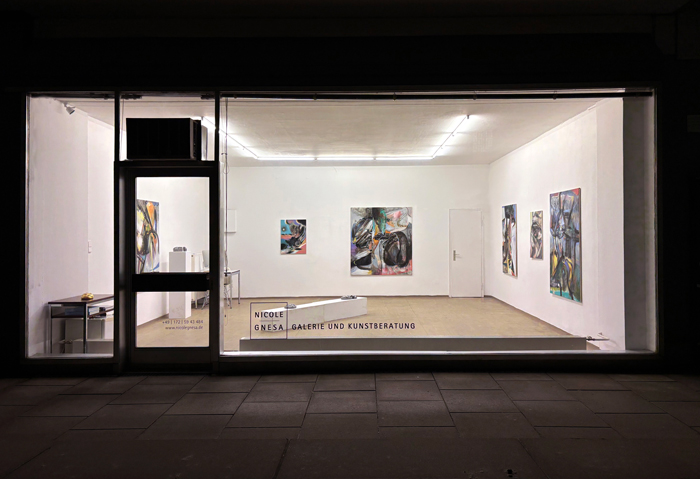
FUZZY CHIMERA Opening reception for the artists: March 12, 2026, 6 pm Exhibition: March 13 - May 2, 2026 Please scroll down for the English version Maurice Merleau-Ponty Formen, Oberflächen und Strukturen ordnen sich scheinbar mühelos ein. Erst im nächsten Moment offenbart sich, dass diese Ordnung brüchig ist. Fuzzy Chimera zeigt neue Arbeiten von Alfredo Barsuglia und Vincent Kern. Ausgangspunkt ist das Gesehene, in dem Vertrautheit und Täuschung zusammenfallen. Alfredo Barsuglias neue Skulpturen wirken aus der Distanz wie amorphe Klumpen. Die Objekte erscheinen metallisch, schwer und fremd, beinahe extraterrestrisch. Bei näherem Hinsehen erweisen sie sich als Brotlaibe. Assoziationen von Einfachheit, Demut und Grundversorgung stellen sich ein. Brot wird als grundlegende Voraussetzung des Lebens lesbar. Die ausgestellten Brotlaibe sind kein Abgüsse in Aluminium, es sind echte Brote, die getrocknet und lackiert wurden, es sind Unikate. Die Wahrnehmung greift vor und fixiert ein Material, das sich im Sehen als Projektion erweist. Nicht das Objekt täuscht, sondern das Bild im Kopf. Mit diesem Moment der Enttäuschung löst sich jede Form von Sozialromantik auf. Das Brot ist weder Monument noch Geste der Bescheidenheit, sondern verfremdet, seiner Funktion als Nahrung enthoben und der Logik des Konsums entzogen. Als Objekt verschiebt sich seine Bedeutung vom Gebrauch zur Zuschreibung. Sichtbar wird nicht der Abguss eines Multiples, sondern eine Erscheinung, die im Vollzug der Wahrnehmung entsteht. Und erst am Ende wird das Material konkret: Handgeknetetes Roggenbrot, ein Stoff mit langer kultureller Geschichte, der in Barsuglias Arbeiten semantisch wie ontologisch radikal verschoben wird. Vincent Kerns neue Arbeiten entfalten einen malerischen Bildraum aus leuchtenden, pastelligen Farben und tiefschwarzen Schlieren. Die Tusche bildet kraftvolle Strukturen, die sich wie Bahnen oder Systeme über die Bildfläche legen. Figürlichkeit scheint auf und entzieht sich zugleich. Körper erscheinen fragmentarisch, Formen bleiben ohne eindeutige Zuordnung. Die Bilder bewegen sich zwischen Zartheit und Kraft. Poetisch helle Farbflächen stehen neben energischen, beinahe technoiden Setzungen. Die Strukturen erinnern an Maschinen, Rohre oder technische Umläufe, zugleich aber auch an digitale Bildlogiken und visuelle Spuren künstlicher Intelligenz. Malerei wird hier zum Ort einer Schwebe zwischen Menschlichem und Technischem, zwischen Geste und System. Technik erscheint nicht als Motiv, sondern als ordnendes Prinzip des Bildes. Die Arbeiten folgen keiner stabilen Logik und kommen nicht zur Ruhe. Überlagerungen, Übermalungen und Korrekturen bleiben sichtbar. Abstraktion ist angestrebt, wird jedoch nie vollständig eingelöst. Das Figürliche kehrt als Rest zurück und hält den Bildraum offen. Verfahren und Bildidee bleiben sichtbar verschränkt. In dieser kontrollierten Anlage öffnet sich ein Raum für das Metaphysische. Kerns Bilder suchen nicht nach Darstellung, sondern nach Annäherung an das, was sich vollständiger Lesbarkeit entzieht. Das Kosmische fungiert dabei weniger als Motiv denn als Konstrukt für Distanz, Unendlichkeit und das Unverfügbare. In beiden Positionen öffnet sich also ein Bezug zum Weltraum. Wärend bei Kern wird dieser explizit wird, etwa in Titeln wie Jupiterbahn, die auf Umlauf, Distanz und Ordnungssysteme verweisen, ohne sie festzuschreiben, bleibt bei Barsuglia das Kosmische implizit. Die Skulpturen wirken auch aufgrund ihrer metallischen Oberfläche fremd, als kämen sie aus einem anderen Zusammenhang, losgelöst von Herkunft und Funktion. Der Weltraum erscheint hier nicht als Ort, sondern als Denkfigur für Entzug, Maßstabslosigkeit und eine Wahrnehmung jenseits des Alltäglichen. In den Arbeiten beider Künstler wird Wahrnehmung nicht als Mittel verstanden, um die Welt abzubilden, sondern als Ort, an dem sie überhaupt erst erscheint. Das Sichtbare verweist dabei immer auf etwas, dessen Bedeutung sich entzieht. Wahrnehmung selbst wird zum Gegenstand, nicht um Gewissheit zu erzeugen, sondern um jene Dimension sichtbar zu machen, in der das Erscheinende mehr ist als das, was gezeigt wird. Die Chimäre bleibt unscharf, nicht aus Mangel, sondern als Haltung. 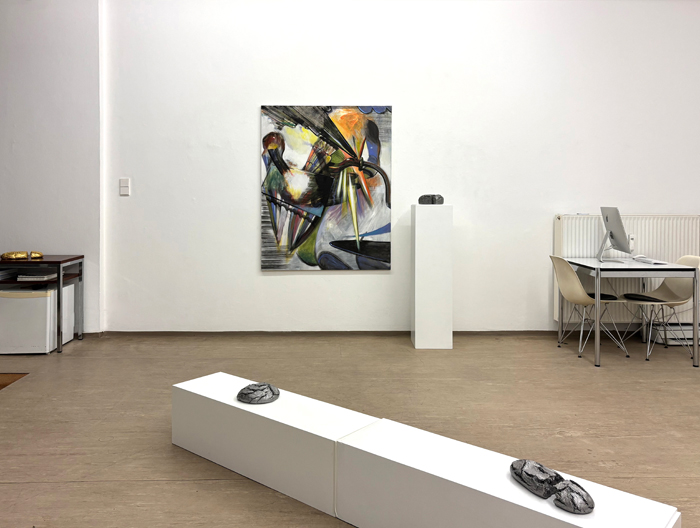 Forms, surfaces and structures seem to settle effortlessly into place. Only in the next moment does it become apparent that this order is fragile. Fuzzy Chimera presents new works by Alfredo Barsuglia and Vincent Kern. The point of departure is the seen, where familiarity and deception converge. Alfredo Barsuglia's new sculptures appear from a distance like shapeless lumps. The objects seem metallic, heavy and alien, almost extraterrestrial. On closer inspection, the forms reveal themselves to be loaves of bread. Associations of simplicity, humility and basic sustenance arise. Bread becomes legible as a fundamental precondition of life. The loaves on display are not casts in aluminum; they are real breads, dried and lacquered, unique pieces. Perception anticipates and fixes upon a material that proves, in the act of seeing, to be projection. It is not the object that deceives, but the image in the mind. With this moment of disillusionment, any trace of social romanticism dissolves. The bread is neither monument nor gesture of modesty, but estranged, removed from its function as food and withdrawn from the logic of consumption. As an object, its meaning shifts from use to attribution. What becomes visible is not the cast of a multiple, but an apparition that emerges in the act of perception. Only at the end does the material become concrete: hand-kneaded rye bread, a substance with a long cultural history that, in Barsuglia's work, is radically displaced both semantically and ontologically. Vincent Kern's new works unfold a painterly pictorial space of luminous pastel colors and deep black streaks. The ink forms powerful structures that spread across the surface like trajectories or systems. Figuration flickers into view and withdraws at once. Bodies appear fragmentary; forms resist clear attribution. The paintings move between delicacy and force. Poetically bright fields of color stand beside energetic, almost technoid interventions. The structures evoke machines, pipes or technical circuits, yet also digital image logics and the visual traces of artificial intelligence. Painting becomes here a site of suspension between the human and the technical, between gesture and system. Technology appears not as motif, but as the ordering principle of the image. The works follow no stable logic and never come to rest. Layers, overpaintings and corrections remain visible. Abstraction is sought, yet never fully achieved. Figuration returns as a residue, keeping the pictorial space open. Process and image concept remain visibly intertwined. Within this controlled construction, a space for the metaphysical opens. Kern's paintings do not seek representation, but an approach to that which eludes complete legibility. The cosmic functions less as motif than as a conceptual figure for distance, infinity and the unavailable. In both positions, a reference to outer space thus emerges. While in Kern's work this reference becomes explicit, such as in titles like Jupiter Orbit, which allude to orbit, distance and systems of order without fixing them in place, in Barsuglia's case, the cosmic remains implicit. The sculptures appear alien also because of their metallic surface, as if emerging from another context, detached from origin and function. Here, outer space appears not as a location, but as a conceptual figure for withdrawal, immeasurability and a perception beyond the everyday. In the work of both artists, perception is not understood as a means of depicting the world, but as the site in which it first appears. The visible always points toward something whose meaning withdraws. Perception itself becomes the subject, not in order to produce certainty, but to render visible that dimension in which what appears is more than what is shown. The chimera remains fuzzy, not out of deficiency, but as an attitude. 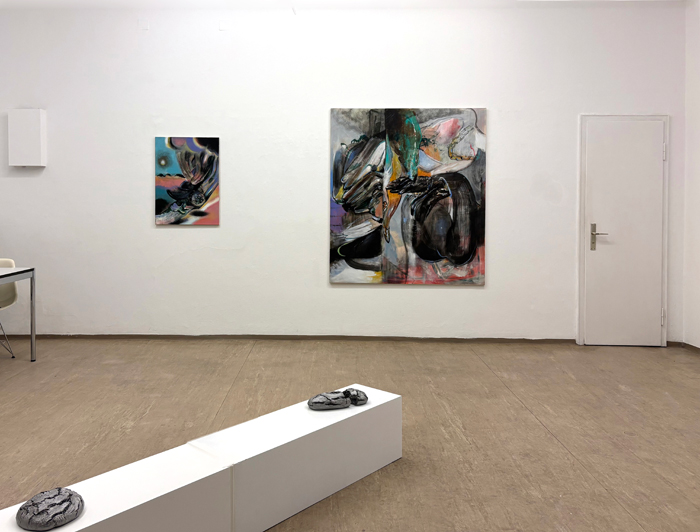 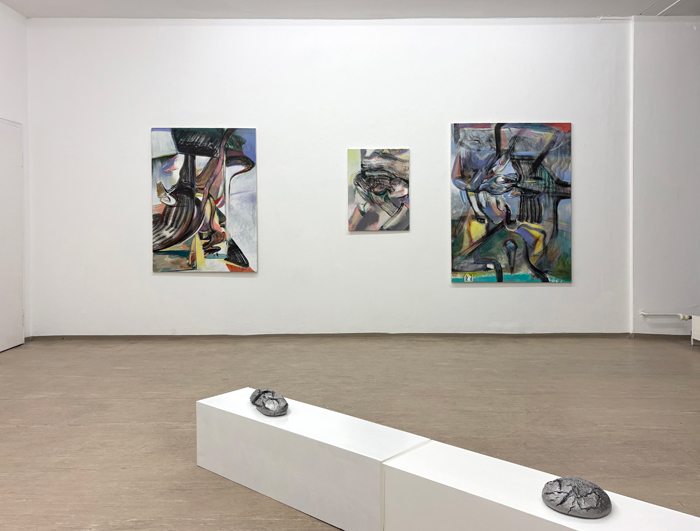
| |||||||